

wolfBoot now runs on the Texas Instruments AM6442, booting signed firmware from OSPI flash on the Arm Cortex-R5F boot core. Alongside the bootloader, wolfCrypt gains a new port for the AM64x SA2UL security accelerator, offloading AES, SHA-2, HMAC, CMAC and random number generation to hardware.
The result is a complete secure boot and update path for AM64x designs, built on the same wolfCrypt engine your application can use for its own cryptography. In our tests on the AM64x EVM, hardware-accelerated SHA-512 runs nearly 6× faster than software, and AES-GCM more than 8× faster.
What’s supported
The AM6442 is a multi-core Sitara SoC with a dual-core Cortex-A53, two dual-core Cortex-R5F clusters, a Cortex-M4F and a dedicated security core. wolfBoot runs on the first R5F core, loaded by the TI boot ROM from OSPI flash. It has been tested on the TMDS64EVM board (rev 101D).
On the bootloader side, wolfBoot provides:
- Signed firmware images, verified with ECC P-256 and SHA-256 before every boot
- Dual-partition updates with fallback: an image that fails verification is never booted, and wolfBoot falls back to the last good image
- ELF loading into on-chip RAM and the R5F tightly coupled memory, then a hand-off to the application through the device firmware
In wolfCrypt, the new SA2UL port accelerates:
- TRNG, in NRBG mode or as an SP 800-90A CTR-DRBG
- AES-ECB, AES-CBC and AES-GCM (128- and 256-bit keys)
- SHA-256 and SHA-512
- HMAC-SHA256 and HMAC-SHA512
- AES-CMAC (128- and 256-bit keys)
The port plugs into wolfCrypt through its crypto callback interface. Applications keep using the standard wolfCrypt API, and any operation the hardware doesn’t cover falls back to software automatically.
Performance
We measured the gains with the wolfCrypt benchmark on the TMDS64EVM, comparing the same build with and without SA2UL acceleration.
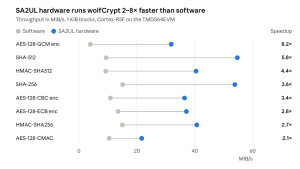
wolfCrypt benchmark on the TMDS64EVM, Cortex-R5F, 1 KiB blocks, October 2026
Getting started
The port builds with the TI MCU Plus SDK for AM64x (v11.02) and the TI Arm Clang toolchain. Setup steps for the SDK and tools are in the TI AM6442 section of the wolfBoot docs/Targets.md.
With the tools in place, build from the wolfBoot directory using the example configuration:
cp config/examples/ti-am64x-r5.config .config
make clean
make PKA=1
PKA=1 turns on SA2UL hardware acceleration; leave it off for an all-software build. Flash the resulting factory.bin to the start of the OSPI flash and set the EVM boot switches to xSPI boot mode.
When you use wolfCrypt directly, these build switches control the SA2UL port:
| Switch | Effect |
|---|---|
| WOLFSSL_TI_AM64X_R5 | Enables all SA2UL acceleration, with the TRNG in NRBG mode |
| WOLFSSL_TI_AM64X_RNG_CTR_DRBG | Runs the TRNG as an SP 800-90A CTR-DRBG instead |
| WOLFSSL_TI_AM64X_NO_AES | Keeps AES in software |
| WOLFSSL_TI_AM64X_NO_SHA | Keeps SHA-2 in software |
Try it
The AM6442 port is open source: the bootloader support is coming to wolfBoot in PR #849, and the SA2UL acceleration is coming to wolfSSL in PR #11121. Building an AM64x product that needs secure boot, secure updates or faster crypto? We’d like to hear about it.
If you have questions, contact us at facts@wolfssl.com or call +1 425 245 8247. For technical support, email support@wolfssl.com.
Download wolfSSL Now