

Scope: the full wolfCrypt algorithm suite vs MbedTLS, measured the same way on four platforms (Intel x86_64, a Raspberry Pi 5 (ARMv8-A Cortex-A76), a bare-metal STM32H563 Cortex-M33, and a Microchip PolarFire SoC RISC-V U54), plus the post-quantum and extended-algorithm coverage MbedTLS does not have. wolfSSL v5.9.1, MbedTLS 3.6.6, June 2026.
Method: identical sources built from source on each target. Every wolfSSL build is tuned for maximum speed (architecture assembly plus single-precision math); The MbedTLS benchmarking runs in its fastest stock configuration on each platform. wolfcrypt/benchmark vs programs/test/benchmark; on the MCU, the same operations are timed with the on-chip DWT cycle counter. Block size 1024 B, about 1 s per algorithm.
wolfSSL and MbedTLS look interchangeable on paper: two small, portable C libraries for embedded TLS and cryptography. When measured, they are not close. wolfCrypt carries hand-written assembly down almost every hot path on x86, ARM, and RISC-V, so the operations that gate secure boot, attestation, and TLS run many times faster than MbedTLS’s portable C. wolfSSL also covers far more ground, including a complete post-quantum CNSA 2.0 suite (ML-KEM, ML-DSA, LMS, XMSS) plus SLH-DSA that MbedTLS does not include. The numbers below are measured, not quoted: one identical operation per algorithm, on four real platforms, with every library built from source with optimization for speed and size based on the scenario.
Intel i9-11950H (x86_64)
wolfCrypt built with –enable-intelasm –enable-sp=yes,asm (AES-NI, AVX2, SHA extensions, single-precision x86_64 assembly). MbedTLS stock Release (AES-NI plus MBEDTLS_HAVE_ASM).
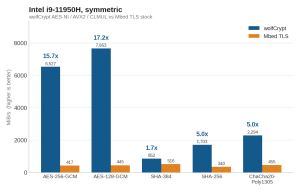
Figure 1. Intel i9-11950H, symmetric throughput (MiB/s).
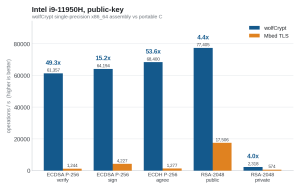
Figure 2. Intel i9-11950H, public-key operations per second.
| Operation | wolfCrypt | MbedTLS | wolfSSL Advantage |
|---|---|---|---|
| AES-256-GCM | 6527 MiB/s | 417 MiB/s | 15.7x |
| AES-128-GCM | 7663 MiB/s | 445 MiB/s | 17.2x |
| SHA-384 | 852 MiB/s | 516 MiB/s * | 1.7x |
| SHA-256 | 1703 MiB/s | 340 MiB/s | 5.0x |
| ChaCha20-Poly1305 | 2294 MiB/s | 455 MiB/s | 5.0x |
| ECDSA P-256 sign | 64,194/s | 4,227/s | 15.2x |
| ECDSA P-256 verify | 61,357/s | 1,244/s | 49.3x |
| ECDH P-256 agree | 68,400/s | 1,277/s | 53.6x |
| RSA-2048 public | 77,405/s | 17,506/s | 4.4x |
* MbedTLS’s benchmark only measures SHA-512, not SHA-384; they share the same core and run at the same speed, so it is the fair SHA-384 comparison.
The biggest gaps are in AES-GCM (wolfCrypt’s AES-NI plus carry-less-multiply GHASH vs a table-based GCM, 15 to 17x) and the public-key operations (single-precision assembly vs portable C, up to 53x on ECDH).
ARM Raspberry Pi 5 (Cortex-A76 @ 2.4 GHz)
wolfCrypt with –enable-armasm –enable-sp=yes,asm. The configure log confirms the ARMv8 crypto extensions are engaged, and AES-256-GCM runs at 1.34 cycles/byte (hardware AES plus PMULL; software AES would be about 25). The same MbedTLS 3.6.6 sources, built on the Pi.
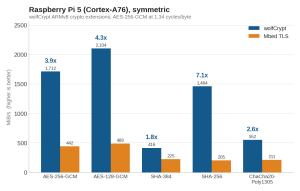
Figure 3. Raspberry Pi 5, symmetric throughput (MiB/s).
Figure 4. Raspberry Pi 5, public-key operations per second.
| Operation | wolfCrypt | MbedTLS | wolfSSL Advantage |
|---|---|---|---|
| AES-256-GCM | 1712 MiB/s | 442 MiB/s | |
| AES-256-GCM | 1712 MiB/s | 442 MiB/s | 3.9x |
| AES-128-GCM | 2104 MiB/s | 489 MiB/s | 4.3x |
| SHA-384 | 416 MiB/s | 225 MiB/s * | 1.8x |
| SHA-256 | 1464 MiB/s | 205 MiB/s | 7.1x |
| ECDSA P-256 verify | 14,933/s | 592/s | 25.2x |
| ECDH P-256 agree | 17,586/s | 637/s | 27.6x |
| RSA-2048 public | 12,226/s | 4,366/s | 2.8x |
* MbedTLS’s benchmark only measures SHA-512, not SHA-384 (MbedTLS supports both; same core and speed). The ARM gap is smaller than Intel’s only because MbedTLS also gets ARMv8 AES on the Pi, whereas on x86 its GCM is stuck on a software GHASH.
STM32H563 (Cortex-M33 @ 250 MHz, bare metal)
Both libraries cross-compiled for the Cortex-M33 and timed on-device with the DWT cycle counter. wolfCrypt uses its Thumb2 assembly for the symmetric and hash primitives (AES, SHA-256, ChaCha20, Poly1305) and its SP Cortex-M assembly for the public-key operations (ECC, RSA). No STM32 hardware crypto block is used: the M33 core has no AES or SHA instructions, so this is hand-written software assembly on both sides. The instruction cache is enabled, as on any real STM32H5 firmware; without it the flash runs at 5 wait states and every result is about 3x too slow.
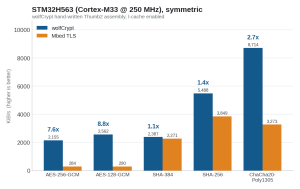
Figure 5. STM32H563, symmetric throughput (KiB/s).
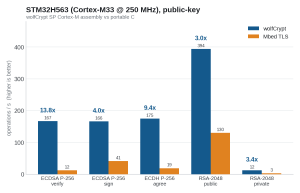
Figure 6. STM32H563, public-key operations per second.
| Operation | wolfCrypt | MbedTLS | wolfSSL Advantage |
|---|---|---|---|
| AES-256-GCM | 2155 KiB/s | 284 KiB/s | 7.6x |
| AES-128-GCM | 2562 KiB/s | 290 KiB/s | 8.8x |
| AES-128-CBC | 5175 KiB/s | 2832 KiB/s | 1.8x |
| ChaCha20-Poly1305 | 8714 KiB/s | 3273 KiB/s | 2.7x |
| SHA-256 | 5488 KiB/s | 3849 KiB/s | 1.4x |
| SHA-384 / SHA-512 | 2387 KiB/s * | 2271 KiB/s | 1.05x |
| ECDSA P-256 verify | 167/s | 12.1/s | 13.8x |
| ECDH P-256 agree | 175/s | 18.6/s | 9.4x |
| RSA-2048 public | 394/s | 130/s | 3.0x |
* SHA-384/512 carries an MCU-specific caveat, and this number is not representative of the assembly’s true speed. SHA-512 (which SHA-384 uses) operates on 64-bit words; wolfCrypt’s fully-unrolled Thumb2 SHA-512 transform is about 12.6 KB, larger than the STM32H563’s 8 KB instruction cache. Run from cached flash it thrashes the cache and drops to 1858 KiB/s, slower than the C transform. Placed in SRAM (a RAMFUNCTION, no flash wait states) the same assembly runs at 2387 KiB/s and beats both. This cache ceiling is unique to this small MCU: on the Intel and Raspberry Pi platforms (48 KB / 64 KB L1 caches) the SHA-512 assembly is never cache-bound, which is why their SHA gaps are larger. We report the SRAM number here; on cache-rich or TCM-equipped targets the assembly wins outright with no special placement.
On the MCU wolfCrypt is faster on every algorithm: 1.8x on AES-CBC, 7 to 9x on AES-GCM, 2.7x on ChaCha20-Poly1305 (all hand-written Thumb2 assembly that fits the cache), and overwhelmingly on the public-key operations that gate secure boot and attestation (ECDSA verify 13.8x, ECDH 9.4x) thanks to its SP Cortex-M assembly.
RISC-V Microchip PolarFire SoC (SiFive U54-MC @ 600 MHz)
wolfCrypt built lean and tuned for speed on the U54: a focused algorithm set with –enable-riscv-asm (hand-written RV64 assembly for AES, SHA-2, SHA-3, ChaCha20 and Poly1305) plus single-precision math for RSA and ECC, the whole library is about 712 KB of code. The MPFS250T’s four U54 application cores are a plain rv64imafdc design with no AES, SHA, bit-manipulation or vector-crypto instructions, so, as on the STM32, this is hand-written software assembly on both sides, not a hardware crypto block. MbedTLS is built from the same sources in its stock default configuration.
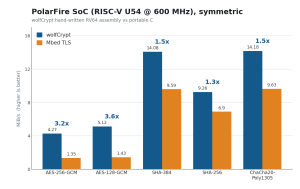
Figure 8. PolarFire SoC U54, symmetric throughput (MiB/s).
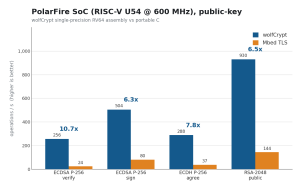
Figure 9. PolarFire SoC U54, public-key operations per second.
| Operation | wolfCrypt | MbedTLS | wolfSSL Advantage |
|---|---|---|---|
| AES-256-GCM | 4.3 MiB/s | 1.3 MiB/s | 3.2x |
| AES-128-GCM | 5.1 MiB/s | 1.4 MiB/s | 3.6x |
| ChaCha20-Poly1305 | 14.2 MiB/s | 9.6 MiB/s | 1.5x |
| SHA-384 | 14.1 MiB/s | 9.6 MiB/s * | 1.5x |
| SHA-256 | 9.3 MiB/s | 6.9 MiB/s | 1.3x |
| ECDSA P-256 verify | 256/s | 24/s | 10.7x |
| ECDH P-256 agree | 288/s | 37/s | 7.8x |
| RSA-2048 public | 930/s | 144/s | 6.5x |
* MbedTLS only measures SHA-512, not SHA-384; they share the same core and run at the same speed, so it is the fair comparison. With no crypto instructions on the U54 both libraries run software-only here.
wolfCrypt is faster on every operation. The public-key gaps are the largest, 6.5x on RSA-2048 public, 7.8x on ECDH and 10.7x on ECDSA verify, because wolfCrypt’s single-precision math outruns MbedTLS’s portable bignum; the symmetric gaps, up to 3.6x on AES-128-GCM, come from wolfCrypt’s RISC-V assembly and a faster GHASH. Enabling the RISC-V assembly on its own lifts the software primitives directly over wolfCrypt’s portable C: ChaCha20 +33%, Poly1305 +25%, SHA-256 +24%, and table-free constant-time AES jumps from 0.12 to 6.4 MiB/s.
What wolfSSL supports that MbedTLS does not
The same speed-tuned build also covers a large set of algorithms with no MbedTLS equivalent. Most important today: a complete post-quantum suite.
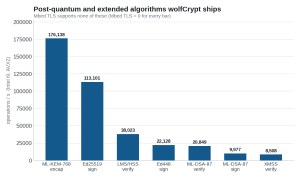
Figure 7. Post-quantum and extended algorithms wolfCrypt ships, ES256-class throughput on Intel i9. MbedTLS supports none of these.
| Category | wolfSSL | MbedTLS |
|---|---|---|
| Post-quantum signatures | ML-DSA-44/65/87 (FIPS 204; ML-DSA-87 verify 20,849/s), LMS / HSS, XMSS / XMSS-MT, SLH-DSA (FIPS 205) | None |
| Post-quantum KEM | ML-KEM-512/768/1024 (FIPS 203; ML-KEM-768 encap 176,138/s) | None |
| EdDSA | Ed25519 (sign 113,101/s), Ed448 | None |
| Identity-based (MIKEY-SAKKE) | ECCSI, SAKKE | None |
| Extra symmetric / hash / KDF | AES-SIV, AES-GCM-STREAM, AES-OFB, SHAKE128/256, RIPEMD-160, BLAKE2b / 2s, SipHash, scrypt, SRTP / SRTCP KDF | None |
Drop-in PSA crypto via wolfPSA
wolfCrypt also implements the Arm PSA Crypto API through wolfPSA, so the speed and coverage above are available without leaving a PSA-based design. On a device already built around Mbed TLS’s PSA crypto (for example under TF-M), you can swap in wolfPSA as the provider behind the same psa_* calls the application already makes: the PSA architecture stays as it is, whilst still getting wolfCrypt capabilities and performance. You keep the PSA-based design and gain the FIPS 140-3 path, the post-quantum suite, and wolfCrypt’s assembly speed in one stack, dropping straight into TF-M or PSA applications.
In practice this means the gaps in the charts above are reachable without a rewrite. The application keeps calling the standard PSA API, wolfPSA routes each operation to wolfCrypt, and the faster AES-GCM, single-precision public-key math, and post-quantum algorithms come with it.
Beyond speed: wolfSSL vs MbedTLS
Speed and algorithm coverage are only part of the story. wolfSSL is a commercially supported, certified library maintained by its original authors, with broad platform reach and a deep feature set. MbedTLS is a community project forked from PolarSSL / XySSL, without the same certifications, breadth, or support. The full comparison:
Technology
| Capability | wolfSSL | MbedTLS |
|---|---|---|
| Ownership | wolfSSL Inc. (single owner) | Multiple owners; forked from XySSL / PolarSSL |
| Development team | Original developers still on the project | Not maintained by the original developers |
| Portability | Portable out of the box: Windows (Win32/64), Linux, macOS, Solaris, *BSD (FreeBSD, NetBSD, OpenBSD), QNX, embedded Linux (Yocto, Buildroot, OpenWRT), iOS, Android, and most RTOSes (FreeRTOS, SafeRTOS, Zephyr, ThreadX / Azure RTOS, VxWorks, Micrium uC/OS-II/III, Nucleus, Green Hills INTEGRITY, SEGGER embOS, Keil RTX / CMSIS-RTOS, TI-RTOS, NXP MQX, Apache Mynewt, NuttX, RIOT, ChibiOS, DDC-I DEOS, TRON / ITRON / uITRON, uT-Kernel), plus bare metal / no-OS, Linux kernel module, Arduino, ARM Mbed OS, Contiki-NG, TenAsys INtime, EBSnet, Nintendo / game consoles (devkitPro), Haiku, HP-UX, NonStop, MontaVista, TinyOS, and AIX | Fewer targets out of the box: Win32/64, Linux, macOS, *BSD, OpenWRT, iOS, Android, SEGGER embOS, Xbox |
| Standards | SSL 3.0 to TLS 1.3; DTLS 1.0 / 1.2 / 1.3 | TLS 1.2 / 1.3; DTLS 1.2 |
| Assembly and CPU acceleration | ARM AArch32 / AArch64 and Cortex-M Thumb-2 assembly, NEON, and ARMv8-A crypto extensions (AES, SHA-1 / SHA-256, SHA-512, SHA-3, SM3 / SM4) plus ARM ML-KEM post-quantum assembly; Intel and AMD x86-64 AES-NI, VAES, PCLMULQDQ (GHASH), AVX1 / AVX2, BMI2 / ADX, RDRAND / RDSEED and Intel QuickAssist (QAT), with AVX2 assembly for ChaCha20 / Poly1305 / X25519; RISC-V RV64 with scalar (Zk) and vector (Zvk) crypto extensions; PowerPC assembly; and single-precision (SP) math in C and assembly for RSA / ECC / DH | AES-NI/CLMUL + Armv8 AES/SHA + bignum asm |
| Hardware crypto and secure elements | STMicroelectronics STM32 (F1/F2/F4/F7, L1/L4/L5/U5, H5/H7, WB, WL, MP13/MP25) PKA / CRYP / HASH and STSAFE-A110; NXP CAAM (i.MX 6/7/8, RT1170), DCP, LTC, Kinetis mmCAU, Coldfire SEC, CASPER and EdgeLock SE050; Microchip PIC32 MX / MZ, ATECC508A / 608A / 608B and TA100; Espressif ESP32 / S2 / S3 / C3 / C6 (AES / SHA / RSA); Renesas RX65N / RX72N (TSIP), RA6M4 / RZ (SCE) and Synergy; Silicon Labs Series 2 / EFR32 (SE, CRYPTO, TRNG); Nordic nRF52840 and nRF51 with ARM CryptoCell-310; Analog Devices / Maxim MAX3266x, MAXQ1065 / MAXQ1080; Cypress / Infineon PSoC 6; Texas Instruments TM4C (Tiva); Xilinx / AMD Zynq UltraScale+ and Versal; Cavium / Marvell Nitrox (III / V) and OcteonTX; Tropic Square TROPIC01; TPM 2.0 (wolfTPM); IoT-SAFE; PKCS#11 HSMs; Linux /dev/crypto, AF_ALG and KCAPI; and the Arm PSA Crypto API for TF-M, NXP SECO (i.MX 8 Security Controller), Raspberry Pi Pico (RP2040), NVIDIA CUDA (GPU AES), AUTOSAR crypto driver (CSM / CryIf), and Renesas RSIP | STMicroelectronics STM32 (CRYP / HASH / PKA); NXP (CAAM, ELS / SSS); Espressif ESP32 / S2 / S3 / C3 / C6 (AES / SHA / RSA); Nordic nRF (Arm CryptoCell CC310 / CC312); Silicon Labs EFR32 Series 1 / 2 (SE / CRYPTO); Renesas RA (SCE); Cypress / Infineon PSoC 6; Microchip ATECC608A and NXP SE050 (PSA secure-element drivers); Arm PSA Crypto API and TF-M |
| Command-line utility (wolfCLU) | Yes | No |
| Certifications | FIPS 140-3 (#4718, #5041); DO-178C DAL-A; ISO 26262 ASIL D | No |
| Certificate revocation | CRL, OCSP, OCSP stapling | CRL |
| Crypto abstraction layer | Yes | No |
| TLS inspection (sniffer) | Yes | No |
| Compression | zlib | No |
| OpenSSL compatibility layer | Yes, 1,600+ functions, actively maintained | Limited, out of date |
| Post-quantum | ML-KEM (FIPS 203), ML-DSA (FIPS 204), SLH-DSA (FIPS 205), LMS/HSS, XMSS/XMSS-MT, Falcon FN-DSA | No |
| Supported open-source projects | OpenSSH, stunnel, wpa_supplicant, lighttpd, cURL, OpenVPN, NGINX, mongoose, and 900 others | Limited |
| Quality assurance | API tests, peer review, static analysis, many compilers and platforms, hardware-accelerated testing, fuzzing (internal fuzzer, AFL, libFuzzer, TLS Fuzzer), big / little endian, known user configs, external validation | Compilation tests, code coverage, regressions, test vectors, interop, build configs, memory checks, fuzzing, static analysis |
| AI | Internally developed Skoll and Fenrir advanced AI static-analysis scanning tools | None |
Support, documentation, and licensing
| Capability | wolfSSL | MbedTLS |
|---|---|---|
| Documentation | Complete: full manual, API reference, build instructions, extensions reference, tutorials, examples, benchmarking | Partial: build instructions, API reference, source |
| Vulnerability response | Fixes typically available within days | Fixes can take months, or not at all |
| License | Dual GPLv3 / commercial | Dual GPLv2 / Apache 2.0 |
| Royalty-free | Yes | Yes |
| Commercial support (up to 24/7) | Yes, from the original developers: email, phone, and forums; tiers from presale to 24/7; response within 3 business days | Community forums only |
Features
| Capability | wolfSSL | MbedTLS |
|---|---|---|
| Randomness / entropy | wolfRAND, NIST DRBG (SHA-256) | DRBG (SHA-1 / SHA-256) |
| Extra hash / cipher functions | AES-SIV / CFB / OFB, AES-GCM-STREAM, SHAKE128/256, BLAKE2b / 2s, RIPEMD-160, SipHash, ECIES, SM2 / SM3 / SM4 | None of these |
| Public-key acceleration | Single-precision math, ECC fixed-point cache | ECC NIST modulo-p speedups |
| TLS extensions | SNI, Max Fragment, ALPN, Trusted CA Indication, Truncated HMAC, Secure Renegotiation, Session Ticket, Extended Master Secret, Encrypt-then-MAC, Quantum-Safe Hybrid, OCSP stapling (v1/v2), Supported Groups, Post-Handshake Auth, 0-RTT Early Data, Cookie; Standards now includes QUIC | Max Fragment, Encrypt-then-MAC |
Bottom line
Built the same way on the same hardware, wolfCrypt is faster than MbedTLS across the board, by 15 to 53x on the public-key operations that gate secure boot and TLS on x86, by 3 to 28x on a Raspberry Pi 5, by up to 14x on a bare-metal STM32H563, and by 6 to 11x on a PolarFire RISC-V with the largest gaps wherever wolfCrypt has hand-written assembly available. wolfCrypt also ships a complete post-quantum suite (ML-KEM, ML-DSA, SLH-DSA, LMS, XMSS), EdDSA, and a wide set of extended algorithms that MbedTLS does not have at all. On top of the speed and coverage, it is FIPS 140-3 validated (certificates #4718 and #5041), DO-178 DAL-A, ISO 26262 ASIL D capable, MISRA C checked, supports the Arm PSA Crypto API for TF-M, and is backed by 24/7 commercial support from its original developers.
Versions and platforms
Libraries: wolfSSL v5.9.1 (dual GPLv3 / commercial), MbedTLS 3.6.6. Tested June 2026.
Builds: wolfSSL tuned for maximum speed on each target. Intel –enable-intelasm –enable-sp=yes,asm; Raspberry Pi –enable-armasm –enable-sp=yes,asm; STM32 Thumb2 plus SP Cortex-M assembly. MbedTLS in its fastest stock configuration (MBEDTLS_HAVE_ASM). Identical sources built from source on every target.
Platforms: Intel i9-11950H, x86_64, GCC 12.2. Raspberry Pi 5, Cortex-A76 at 2.4 GHz, Debian 12, GCC 12.2. STM32H563 (NUCLEO-H563ZI), Cortex-M33 at 250 MHz, bare metal, arm-none-eabi-gcc 13.2, instruction cache enabled. PolarFire SoC Video Kit (MPFS250T), 4x SiFive U54-MC at 600 MHz, Yocto Linux 6.12, GCC 13.3.
Measurement: wolfcrypt/benchmark vs programs/test/benchmark on the desktop and server targets; on the MCU, the same operations timed with the on-chip DWT cycle counter. Block size 1024 B, about 1 s per algorithm. Symmetric in MiB/s or KiB/s, public-key in operations per second.
If you have questions about any of the above, please contact us at facts@wolfssl.com or call us at +1 425 245 8247.
Download wolfSSL Now